
COMMON PURPOSE
How We Got Here: The Lost American Dream
I offer nothing more than simple facts, plain arguments, and common sense.—
Meet Kayla, age 27, who struggles to make ends meet even when everything at work and home is “normal.” She works as an emergency medical technician (EMT) in a large North Carolina county that is mostly rural. It’s considered a “good” job—she pulls down about $40,000 a year—mostly because there’s always work and layoffs are almost unheard of. Her shifts are long—12 to 14 hours—and often unpredictable. She and her partner share care for their three-year-old son. Living had been hard, but manageable.
Things got more difficult when her partner’s job relocated out of state and Kayla suddenly became a single parent. The childcare center she relied on closed unexpectedly after losing staff. The only available alternative charges nearly $1,600 per month, which would be a wholly unmanageable percentage of their combined monthly income. She’s been forced to cobble together care from neighbors and relatives, frequently calling in for unpaid leave when coverage falls through. Each missed shift reduces her paycheck and jeopardizes her standing at work. In her job, Kayla saves lives daily, but now, with literally no savings and her family’s income having to cover living costs in two places, her own life is beginning a downward spiral.
Meet Henry, 28, who like Kayla is representative of far too many working Americans today. He always wanted to be an elementary school teacher, and took on debt to study early childhood education in college. He was excited to find a position teaching second grade in a public school outside Denver, at a pre-tax salary of $53,000—about what many first-year teachers earn. He quickly became the kind of teacher who stays late to help struggling readers.
Henry’s other dream was to start a family. He met Nora; they fell in love and married. Combining his income with Nora’s from her low-paying manager job at a local nonprofit homeless shelter didn’t help as much as Henry had hoped. When they welcomed their son Charlie 18 months later, they barely had enough room, but renting or buying a larger place was out of the question. They did decide that Nora would become a stay-at-home parent during the baby’s first years—as their own moms had done.
Things became precarious on one income. Their rent went up. Henry’s share of health insurance premiums rose. Everyday prices for groceries, utilities, and diapers climbed steadily. There was nothing left at the end of each month. Nora couldn’t go back to work because the childcare costs were prohibitive. Henry took a second job stocking shelves three nights a week, leaving him exhausted after preparing lessons well past midnight. The fatigue dulled the very patience and creativity that had made him a great teacher. And on top of that, their money situation forced him and Nora to make a heartbreaking decision: no more children.
Henry and Nora simply couldn’t afford the life they had hoped to build for themselves in the jobs they had chosen. A couple of years later, Henry left the classroom for a corporate training job that paid enough to support his family without working a second job. The move was practical and responsible—but it shut the door on Henry’s long-held dream, and the classroom lost a teacher who never wanted to leave.
Meet Claire, who is 41 years old and has spent nearly a decade as a home health aide for the elderly in suburban Florida. She works six days a week, often 12-hour shifts, and is ineligible for overtime pay because under state law she’s paid as a “companion” through an agency. Her annual income from her job rarely exceeds $35,000—far below what’s needed to meet basic needs where she lives. She takes side gigs cleaning houses as often as she can.
With rent consuming 50 percent of her paycheck and with no paid sick leave, Claire has zero basic security. She is in constant fear that one little thing will mean losing her apartment and possibly end her ability to work at all.
Stories like these can be found in every part of America, where millions and millions of working Americans are barely surviving and certainly not thriving. Kayla, Henry, and Claire have been doing everything right, and yet no longer enjoy even a modicum of the security America once provided. The situation in our country forces people to choose careers based not on their interests, but on whether they can make enough money, often just to get by.
Data turn the sense that we’ve lost the American Dream into undeniable fact. Data, for instance, show Americans abandoning their personal dreams for the future—dreams about careers or starting a family.
- Over the 11 years from 2013 to 2024, the number of people in our country completing teacher preparation programs dropped by more than 20 percent. Today, 87 percent of teachers express concern over low pay and 40 percent work extra jobs. Americans like Henry who dreamt of becoming teachers are taking different routes because they cannot imagine a thriving life working in our schools.
- The share of American adults under 50 without children who say they are unlikely to ever have them rose significantly in just five years, from 37 percent in 2018 to 47 percent in 2023. More than a third of those people cited being unable to afford children as a major reason. Some fear in advance the very childcare-related financial crisis Kayla is confronting. The dream of having a family is disappearing.
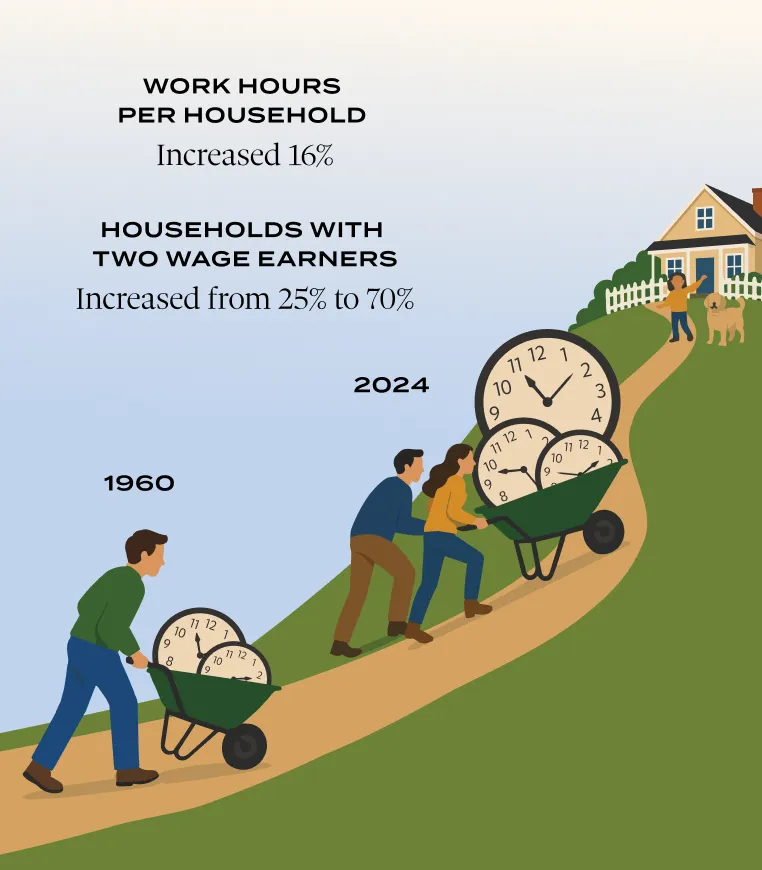
- Since 1960, American households have undergone a quiet but profound shift. Then, most families relied on a single income; today, the majority depend on two—and even with total household working hours increasing by roughly 16 percent, financial security has not followed. The new reality is that it takes two people working more hours to achieve what one income once provided, and even with two incomes many families feel increasingly behind.
The lived reality for tens of millions of us is decade upon decade of stagnation. This, too, is demonstrable—with more data that show just how off-track we are as a country.
- Over the past several decades, the US economy has grown dramatically. Since the late 1970s, worker productivity has risen three times faster than typical worker pay. Wages barely keep up with inflation in basic needs like food, housing, healthcare, and child-care. For millions of working families, the result is a growing sense that even when they work hard and play by the rules, getting ahead feels impossible. It’s no surprise that a poll released in late 2025 found that 69 percent of us believe that the American Dream no longer holds true or never did—the highest level of skepticism in nearly 15 years of surveys.
- Roughly 53 million full-time workers in the United States—about 44 percent—earn less than what they need to meet basic living costs in their local areas. For families with children—especially single parents—the income required rises steeply, making shortfalls both more common and more severe.
- For the last 15 years, Americans on average have been paying between 17 and 21 percent of their income for childcare—nearly triple what the federal government defines as “affordable.” Henry and Nora’s lived reality reflects the true situation. No wonder our friends and neighbors are reluctantly deciding not to start families.
- For years, we’ve known that children who cannot read well by the end of third grade face steep odds in the rest of school and in all their future endeavors. Today, millions of American children are already behind even before reaching age 10. Nationally, progress on early reading has largely stalled, and roughly two-thirds of fourth-graders in US schools are not proficient readers. National reading scores have actually declined since the late 2010s.
Americans are working more for less financial security.
This is not what America is supposed to be. How did we become a country with so many of our people so close to economic collapse, with so many people we’ve failed to elevate beyond simply getting by, with so many people forced to avoid taking essential jobs or starting a family?
It’s not that we didn’t try. For decades, going back to the 1960s, our government has tried to address the challenges that arise from Americans not being paid wages that keep up with the cost of living. Major new programs were launched to “fix” housing, the “problems” of the cities, rural poverty, and other challenges. Federal funding for education expanded throughout all 50 states. Medicare and Medicaid were launched. Rent subsidies were established for low-income families, along with grants to rehabilitate homes and comprehensive urban renewal for blighted neighborhoods in major cities. We tried to create and sustain a “social safety net”—a tremendously ambitious effort, but clearly not what was and is necessary to keep us from falling to where our country is today.
The federal government spends more than $1 trillion each year on well-intentioned, means-tested safety-net programs aimed at helping people survive in times of need. Trillions more are spent on human services, community improvement, and K-12 education. America also has a vast charitable sector of 1.9 million nonprofits and more than $500 billion in annual philanthropic giving. All this money, though, translates into only incremental change. Sure, we may be making some difference in hundreds of thousands of individual lives, but we rarely change outcomes at scale or shift the overall pattern of results.
The record suggests something that may seem counterintuitive: We have not been measuring success correctly. Success should be defined by more working Americans thriving.
So much money expended for so little structural, long-term change, and for no measurable difference in restoring the American Dream for our country as a whole. Meanwhile, the challenges working Americans face become more and more difficult for most, and even more acute for some who live in certain zip codes and/or are people of color.
At the same time, the wealthiest in our country are impervious to the costs of basic necessities that average working Americans face. They do not have to put in the hard work to make ends meet, but instead are guaranteed, almost every day, to have accrued greater wealth through their investments in stock and bond markets, real estate, and so on.
What explains the lack of progress by everyday working Americans? Could our focus on people surviving be the problem? The record suggests something that may seem counterintuitive: we have not been measuring success correctly. Success should be defined by more working Americans thriving.
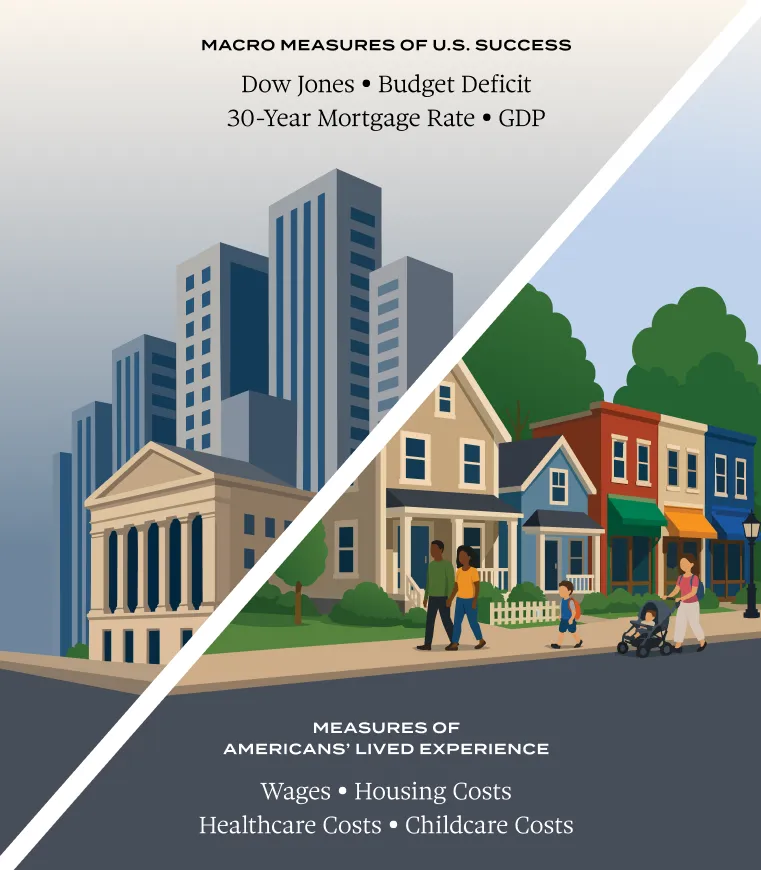
The current measures we focus on today must be augmented with others. The current measures are divorced from the daily lived experiences of most Americans. They have created a picture behind which to hide from confronting our stagnation. How the stock market is doing has little direct impact on the financial wellbeing of most Americans; Wall Street shouldn’t be the only “street” we measure.
GDP growth tells us nothing about how and whether the wealth that growth produces is reducing inequality. The unemployment rate misses that the issue today is not whether people have jobs, but whether they have jobs that pay enough to cover expenses and allow them to save enough for emergencies, let alone for other non-essential expenses—including things that just make life worth living each day. Tracking whether people have places to live masks whether they can actually afford what housing costs. When “basic needs” are defined as those that keep you merely surviving, it becomes clear why we’re not actually improving people’s overall situation.
Our focus must be on measurable outcomes that translate into making a real difference in moving people from surviving to thriving. Without a new set of additional measures as our guide, decades of money and effort will continue to be squandered.
We once had a functioning “social contract” that underpinned the American Dream. That contract meant that for most of us, if we worked hard we’d be able to afford a decent, stable life. If we followed the rules, we’d be treated fairly. If we paid our taxes, we’d get roads, schools, safety, and opportunity in return. But now, if housing eats up 50 percent of your income, childcare costs consume a huge portion of what’s left, and a single medical event can put you and your family in bankruptcy, that “social contract” feels broken.
We measure Wall Street. Why not Main Street?
The fight for survival has driven a wedge between us as Americans that obscures our recognition that we all share
a Common Purpose.
That break erodes trust in our country and in the very institutions that make up the “system” that’s supposed to work for us. An erosion of trust is a recipe for growing polarization—exactly what we see today. The situation has spawned divisions and distractions so profound that we can’t even seem to agree on who to hold accountable for what we face.
The fight for survival has driven a wedge between us as Americans that obscures our recognition that we all share a Common Purpose. Surely a belief in the American Dream, deserved by all of us, still lives deep down in all of us—even if only as a fading ember. But just as surely there is tremendous angst, sometimes unspoken and sometimes eruptive, that comes from sensing that the bargain has been changed.
Our partisan battles only divert our attention, speed the decline of our country, fuel our discontent, and further sever our connection to a Common Purpose. In Thomas Paine’s time, the injustice of America’s situation came from a king across the ocean, a Parliament that taxed without representation, and its administrators in the colonies. Today, unlike in Paine’s time, our common enemy is internal. We’ve let this happen, largely because so many of us have been so busy just trying to get by—and there are so many issues to address that it is nearly impossible to focus or keep track. As the promise of America has eroded, we have accepted surviving in place of thriving. We have resigned ourselves to our lot in life. We have come to believe, often quietly, that nothing fundamental can change. We have shown a willingness to fight one another while ignoring the structural decline of opportunity. And so now we tolerate a system that rewards fewer and fewer and excludes more and more of us, while telling ourselves that this is inevitable. Inequality has become the quiet architect of our polarization. As economic distance widens, so too does emotional and political distance—corroding the possibility of again sharing a Common Purpose.
We are at a moment of profound crisis, of reckoning. But we are not powerless to change this situation.
In the wealthiest nation in human history, we are restrained not by scarcity or capacity, but by our reluctance to insist that opportunity be real and measurable.
The American Dream will not restore itself. It will not reappear simply by being invoked and defended in speeches. It will not strengthen because we defend it with rhetoric. It will return only if we decide that survival is insufficient and that thriving must become our country’s standard. It will return only if we unite in Common Purpose, show the will to change, and demand of our leaders that they work with us to change the circumstances that have gotten us to this point.
This is a call for a Common Purpose that rests on the shoulders of the best America—the America that is, first and foremost, a kind nation, a caring nation, a nation that volunteers, that donates, that steps forward to help our neighbors in times of crisis.
Again, we as a nation should be judged by whether greater numbers of working Americans are thriving.
What is proposed here is an undertaking that will require engagement, dialogue, compromise, and transparency at levels we have perhaps not seen since our forefathers’ founding of our great nation. It is only then that we can rebuild trust and maintain the disciplined action that will give us hope for renewing the American Promise.
That means a new kind of movement.