
COMMON PURPOSE
A Movement to Renew America’s Promise
An Outcomes Movement will not just emerge because we decide it’s worthy of pursuing. It cannot be left completely up to others. A good place to begin is to recognize the three central requirements for launching such a movement: establishing the outcomes on which to focus; building a strong data infrastructure; and ensuring transparency.
1. Outcomes that Matter for Working Americans
First and foremost, an Outcomes Movement needs to focus on the persistent challenges that reflect the lived experience of people across our country. That means employing outcomes measures that represent what it takes to be a thriving American.
Of course, every state, region, city, town, and neighbor-hood will have its differences, but outcomes measures fall into at least seven clear, measurable areas that truly do matter because they affect so many Americans and offer clear distinctions between surviving and thriving. These are the outcomes areas where we know people fall through the cracks, where lives of just getting by become lives of increasingly desperate economic and emotional challenges. Every one of them can be addressed at a community, state, and federal level.
The outcomes areas that are essential are accompanied here by specific suggested outcomes measures as a way to guide and discipline the discussions and debates in which communities will need to engage.
Wages
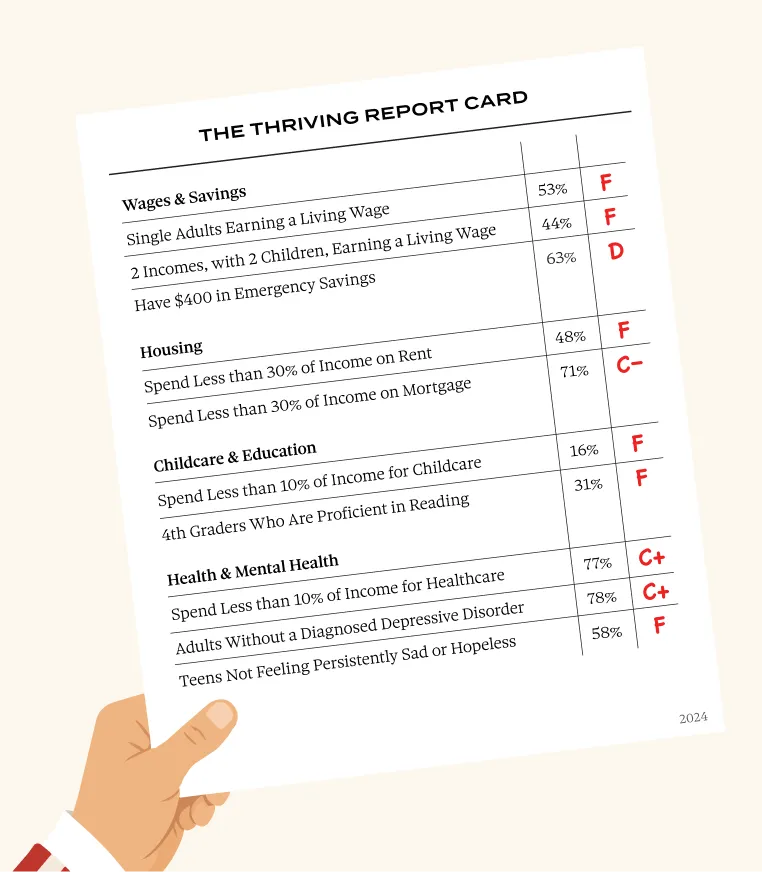
A meaningful Outcomes Movement for working Americans needs to focus on the percentage of Americans earning a living wage—the minimum income necessary for a worker to meet basic needs, the sort of wage that breaks the cycle in which life is a daily constant struggle simply to survive. A living wage is not the “minimum wage” that varies widely across the country—and tells us nothing about what people actually need to do more than barely survive. Still, ensuring a living wage is a solid first step before we can do anything that genuinely aims at ensuring a thriving wage and truly gets working Americans beyond the persistent potential for one-paycheck-from-catastrophe scenario. If wages are insufficient to give an individual or a family some stability, to allow for meeting basic needs and building some modest savings and having some extra left over to enjoy life, then something fundamental is broken in the relationship between work and living.
Housing
An Outcomes Movement should measure the percentage of people in our communities paying no more than 30 percent of income on housing. That’s because just having and keeping a place to live has become a daily challenge for tens of millions of Americans—including many with full-time jobs. It’s not how much housing costs but the percentage of income spent on housing that matters most. Housing is the single largest expense for most families. Stability erodes when rent or mortgage payments consume more than 30 percent of income, an affordability standard of the US federal government. When the cost of housing is at a “severely cost-burdened” 50 percent or more, crisis is inevitable. We cannot claim progress toward restoring America’s promise if housing remains structurally unaffordable.
Education
Almost every aspect of education is a big, complex challenge and the subject of ongoing debate. One thing is certain: we know all kinds of education are key to whether working Americans thrive. Yet the link between schooling and securing a good-paying job is weaker than perhaps ever before in our history. An Outcomes Movement focused on education requires a tough choice: Where to start? Reading proficiency has long been a strong evidence-based predictor of future educational attainment and lifetime earnings. An Outcomes Movement should measure the percentage of America’s children who can read proficiently by the end of 4th grade, which today stands at a staggeringly low 31 percent—a number largely stagnant for decades. Creating opportunity demands we move this number. Success will empower us to address other aspects of education in new ways, from crushing student debt to a stronger guarantee that continuing with school leads to long-term financial security.
Childcare
Childcare is, for the most part, widely available across America. The challenge is whether families can afford childcare without sacrificing financial stability. The federal government’s definition of affordable childcare should be our measure: childcare consuming no more than 10 percent of a household’s income. Today, though, nearly every family paying childcare costs in our country—an outrageous 84 percent—spends more than that, forcing them to make impossible tradeoffs between work, savings, and basic needs such as food and clothing. Unaffordable childcare also pushes parents—especially mothers—out of the workforce, causes increased family stress, and stalls economic mobility.
Savings
For far too many Americans, even a small “wrong turn” in life through no fault of their own—a sudden car repair; an unexpected medical bill; a broken appliance—can quickly become a financial crisis. Families without some savings live constantly on the edge, where a single disruption can cascade into missed rent, job loss, and even long-term hardship. The US Federal Reserve reports that the percentage of Americans with sufficient savings to cover at least a $400 emergency today stands at only 63 percent. To start, this should be our measure in an Outcomes Movement. Only resilience can combat the persistent one-paycheck-from-catastrophe scenario that permeates our communities. Otherwise, Americans find themselves forced to miss payments, incur ongoing late fees, sell things that matter to them, or take out loans at outrageously high interest rates just to survive.
Health
Health—foundational to every other outcome—is, like education, a big, complex challenge for our country. If you’re not healthy, it’s nearly impossible to meet your personal and professional responsibilities. Poor health costs the US economy an estimated half-trillion dollars annually because of missed workdays and reduced on-the-job productivity. Access, cost, and quality are all pressing issues, but we need a place to start—and affordability makes sense. Affordable healthcare costing less than 10 percent of a household’s income is a commonly used benchmark, including by the US Department of Health and Human Services, but roughly one in four working-age Americans spends well more than that—including on insurance premiums, which leads to many being underinsured. In other words, even having health insurance no longer ensures that healthcare is affordable.
Mental Health
It may be surprising to see mental health included with measures such as housing and savings, but it is a crisis we cannot ignore if we expect Americans to truly thrive. In the specific context of an Outcomes Movement, the best outcomes measures of mental health are still evolving, and different states are exploring a variety of approaches at the community level. The CDC collects data that give us a place to start—reducing the percentage of adults 18 and older who have been told by a healthcare professional that they have a depressive disorder, major or minor, which stood at 22 percent in 2024, and reducing the percentage of high school students reporting persistent feelings of sadness or hopelessness, which rose sharply from 28 percent in 2011 to a shocking 42 percent in 2024. No society prospers with anxiety, depression, and despair on the rise. We cannot claim progress toward restoring America’s Promise with this major barrier to thriving, when so many people suffering in ways deeply felt but often unseen by others.
How are Working Americans Doing?
2. A New Era of Public Outcomes Data
To track our progress and ensure our ability to make adjustments, an Outcomes Movement will require a new era of publicly accessible outcomes data—an opportunity because of how far we already have come in our collection and use of data.
Fortunately, governments—federal, state, and local—already collect enormous amounts of data that allow us to track most of the outcomes measures suggested. We do need to make some changes. Much of the outcomes data collected is fragmented, outdated, or difficult to gather; and outcomes data needs to be standardized, further disaggregated, and collected in a timelier manner. Today’s AI, carefully incorporated, can help us do more with data by both accessing and analyzing it better and faster. Carefully trained AI could also help identify questions and issues that may not be obvious.
Outcomes data on third-grade reading proficiency offer a powerful model for other outcomes data collection. Today, student data is disaggregated down to the individual school level (a proxy for communities), and then by race, gender, and other critical demographics. The greater the specificity of outcomes data, the better the measures will work to provide transparency and more effective policy, program, and resource allocation debates.
3. Transparency
An Outcomes Movement will democratize data to ensure full transparency. That, in turn, is what allows for meaning-ful measurement and makes accountability possible. Fully transparent outcomes data create a sort of permanent negotiating table around which people can gather to talk about real, quantifiable issues, engage in policy debates, shift gears collectively, and maximize the probability of success.
Achieving full transparency requires a mechanism that is accessible to and usable by anyone and everyone, wherever: individual community members, local governments, nonprofit coalitions, philanthropic organizations, schools, as well as at the state and federal levels of government. That mechanism must mirror the principle that clarity precedes action, which is central to an Outcomes Movement.
Dashboards are a tested example of the kind of mechanism we need. They are common in many sectors, including business and healthcare as well as with governments, as a way to keep track of outcomes. In an Outcomes Movement, a dashboard can display the outcomes measures a community has chosen and track the baselines a community has set to make progress transparent on a consistent basis. They are a way to disaggregate data by income, geography, gender, or other demographic characteristics in order to reveal disparities that overall averages might conceal, further helping us reach the clarity we aim for.
Dashboards also function as mechanisms for sustained accountability, becoming the reference point against which leadership, investment, and policy are judged and making it more difficult to undercut progress when there are transitions in leadership. A dashboard is a shared civic scorecard that allows for measuring whether a community is advancing or drifting. It transforms “progress” from anecdotal to demonstrable—making stalled progress visible and progress achieved verifiable.